Patented Air Treatment Technology
The Air Purification Reactor That Destroys Pollutants Instead of Trapping Them
NCCO (Nano Confined Catalytic Oxidation) is a self-regenerating treatment system developed by RHT Industries in Hong Kong. It breaks down contaminants into water vapor and CO₂ — then keeps going. No filter replacements every quarter, no re-emission risk, no secondary pollution.
Activated carbon stores pollution. What happens when it fills up?
Standard HEPA and activated carbon filters capture contaminants but cannot destroy them. Once saturated — often within 3 months — they release trapped toxins back into the airstream. Performance is also significantly affected by humidity. Your "air purifier" becomes a pollution source.
Saturation
Carbon filters absorb pollutants until they cannot hold any more. Then re-emission begins.
Re-emission
Trapped VOCs, formaldehyde, and bacteria release back into indoor air once the filter is full.
Waste Cycle
Spent carbon filters end up in landfills every quarter. Multiply that across hundreds of units.
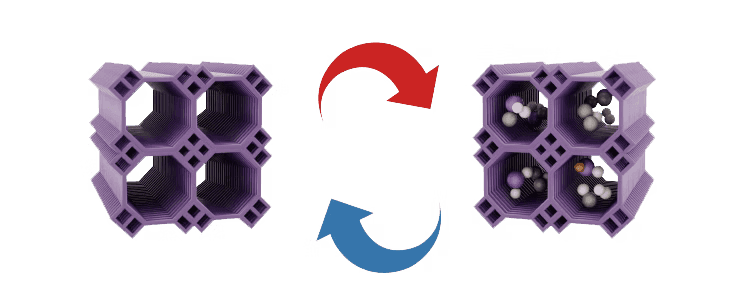
Four stages. One continuous cycle.
Contaminants enter the reactor, get locked inside the zeolite matrix, react with embedded catalysts, and exit as harmless water vapor and CO₂. Then the reactor resets and does it again.
Nano
Molecular Capture Surface
A zeolite mineral matrix engineered at nanometer precision. Each granule — smaller than a pea — packs the adsorption surface of a tennis court. Contaminant molecules get drawn in and held at the molecular level.
Confined
Selective Pollutant Locking
The zeolite's crystalline pore structure acts as a shape-selective trap. Only targeted contaminant molecules fit — everything else passes through. No wasted capacity, no accidental capture of benign compounds.
Catalytic
Continuous Decomposition
Transition metals impregnated within zeolite pores accelerate oxidation reactions between trapped pollutants and the oxidizing agent. The catalyst participates in thousands of reaction cycles without being consumed.
Oxidation
Clean Output Only
Active oxygen generated within the system oxidizes gaseous contaminants into water vapor and carbon dioxide. The catalytic material regenerates and is ready for the next adsorption cycle. No residue, no re-emission, no saturation — ever.
Built for Commercial Environments
That Cannot Afford Air Quality Failures
Hospitals, banks, airports, data centres — facilities where "good enough" filtration is not acceptable.
Never Reaches Saturation
Activated carbon stops working once its pores fill up — and then releases trapped toxins back into the air. NCCO decomposes pollutants instead of storing them. The reactor keeps running indefinitely.
Zero Secondary Emissions
No ozone byproduct. No re-released VOCs. No spent filter waste entering landfills. The only outputs are water vapor and CO₂ — the same compounds you exhale.
Cuts Scope 3 Carbon Footprint
Longer-lasting reactors mean fewer replacements, less shipping, less manufacturing overhead. CMA-verified 44% CO₂ reduction versus activated carbon alternatives across the product lifecycle.
Lowers HVAC Operating Cost
NCCO-treated air stays cleaner longer, which means buildings can reduce ventilation frequency without compromising air quality. Direct energy savings on heating and cooling.
Carbon Credit Generation
Quantified, verified emission reductions qualify for carbon credit certificates through CMA and the Global Carbon Trading Centre. Over 4,400 tonnes CO₂e already retired.
Independently Verified
Test results from Intertek, CMA Testing, and UBC confirm removal rates above 99% for pathogens, VOCs, and particulates. Published in peer-reviewed Springer Nature research.
Published removal rates. Not marketing claims.
Independently tested by Professional Inspection Testing Ltd. (Report No. TRI220400001).
Pathogen Elimination
Chemical & Particulate Removal
Academic Validation
A University of British Columbia study (Kwok et al., 2021) published in Springer Nature confirmed NCCO achieves 93.4% reduction in cannabis chemicals and 55.6% odour reduction in controlled field trials.
Read Published Research →Certified & Verified By
Your building deserves better than a filter that re-releases pollution.
From site inspection to installation to ongoing maintenance — one professional partner, end to end.